
Follow the jackpot research
Most progressive jackpots can, in principle, grow forever until someone wins them. A must-drop jackpot is different: it has a ceiling, and it must pay out before reaching it. Some are tied to time instead, such as daily jackpots that must drop before a set hour. These rules sound like a hidden advantage for players. Sometimes they shift the numbers a little; they never remove the house edge.
How a must-drop jackpot works
| Feature | What it means |
|---|---|
| Seed value | The amount the jackpot resets to after a win |
| Ceiling ("must drop by") | The maximum the jackpot can reach before it must be won |
| Drop point | A value between the seed and the ceiling, chosen at random when the jackpot resets |
| Contribution | The share of each stake that feeds the pool |
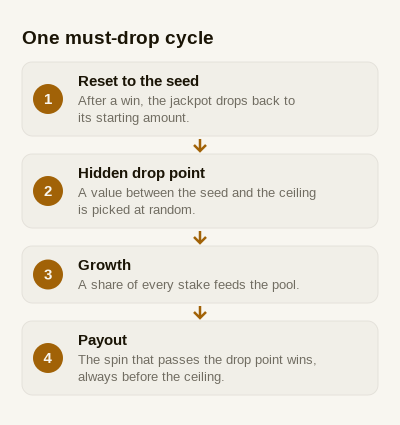
When the jackpot resets, the system secretly picks the drop point at random somewhere between the seed and the ceiling. The jackpot is won by whichever spin pushes the pool past that point.
Worked example: Invented figures. A jackpot resets at 1,000 and must drop by 5,000. After a win, the system picks a drop point at random between those values, say 3,260. Nobody knows that number. The jackpot grows with each stake and is paid on the spin that takes it past 3,260.
Daily jackpots
Time-based versions work the same way with time instead of money: the jackpot must drop before a set time each day, and the exact moment is chosen at random in advance. The jackpot will be won by someone every day; which spin wins is still a matter of chance.
Does it matter how close the jackpot is to the ceiling?
Yes, in a narrow sense. If, as is common, the drop point is equally likely anywhere between the seed and the ceiling, a jackpot near its ceiling is more likely to drop soon than one that has just reset. When the jackpot is very close to the ceiling, almost all of the remaining range has been used up.
But three things limit what that means for a player:
- Your chance of being the one who triggers it still depends on how many others are playing and how much you stake.
- The base game keeps its house edge. The jackpot's contribution is taken from every stake, before and after the drop.
- Everyone sees the same meter. If a jackpot is close to its ceiling, more players join in, and your share of the chance shrinks.
Key point: A must-drop jackpot changes when the prize is paid, not how much the game returns overall. Across many cycles, the jackpot pays out roughly what players contributed to it.
How to think about the numbers
Over a full cycle, if the drop point is equally likely anywhere in the range, the jackpot's average prize is about halfway between the seed and the ceiling. If you play only when the meter is high, you are playing in the part of the cycle when a drop is more likely, but you still pay the same contribution and house edge on every spin, and you compete with every other player watching the same meter.
Watch out: Waiting for a jackpot to "be due" and then increasing stakes is a version of chasing. The base game still loses on average, and the extra spins add up. Set your limits before you start.
For how the jackpot is funded and what it adds to the RTP, see How Progressive Jackpots Work. To estimate a jackpot's contribution to the return at its current size, use the jackpot odds and break-even calculator. To put numbers on a ceiling, use the must-drop calculator.
- A must-drop jackpot has a ceiling and a hidden, randomly chosen drop point between the seed and the ceiling.
- Near the ceiling, a drop is more likely soon, but your share of that chance depends on everyone else playing.
- The base game's house edge and the jackpot contribution apply on every spin.
Distinguish a bound from a personal promise
Check whether the rule concerns a prize ceiling, a time window or a specific eligible event. A guaranteed drop under a game's mechanism does not guarantee that a particular player wins. Read eligibility and contribution conditions without treating proximity to the bound as a reason to increase spending.
18+ only. Jackpots are very long shots. See our Responsible Gambling page.